First-Gen & Low-Income Student Research
Overview
Before I designed or coded a single screen of Trailmaker, I needed to know whether the problem I thought I was solving was the problem first-generation and low-income (FGLI) students actually had. I'd lived one version of that story myself, but a sample size of one isn't research — so I ran a mixed-methods study with 16 FGLI college students to find out where the college process actually breaks down, and let their answers, not my assumptions, set the direction for the product. This case study is that research, on its own: the design decisions, the raw data, and how each finding became a specific product decision. (The resulting product is its own case study — Trailmaker.)
Research Design
I chose a survey as the primary instrument, followed by informal 1:1 interviews, for a practical reason: FGLI students are a population that's hard to reach in large numbers as an independent student researcher, and a survey let me collect both closed and open-ended responses at a scale interviews alone couldn't, while the interviews let me probe the "why" behind answers that a form couldn't capture on its own.
I wrote the FGLI Student Questionnaire in Google Forms: two screening questions (do you identify as low-income and/or first-generation), then open-ended questions covering the application process, feeling equipped for college, the impact of being FGLI on their college and career trajectory, resources used, and job-search readiness. I told respondents upfront that participation was anonymous and answers would be kept confidential, and I recruited through FGLI-specific student programs and communities rather than a general student listserv, so the sample was self-selected toward students who already identified with the FGLI experience.
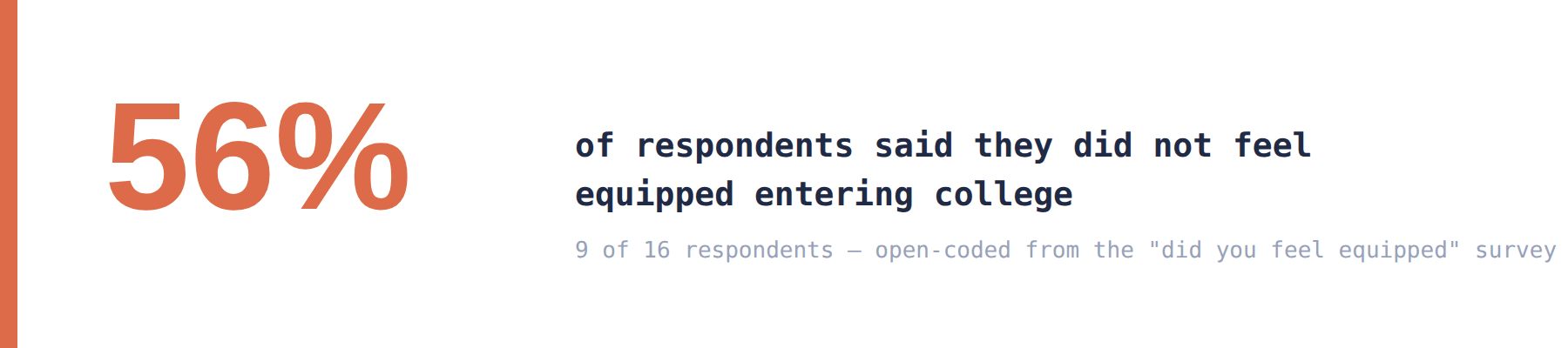
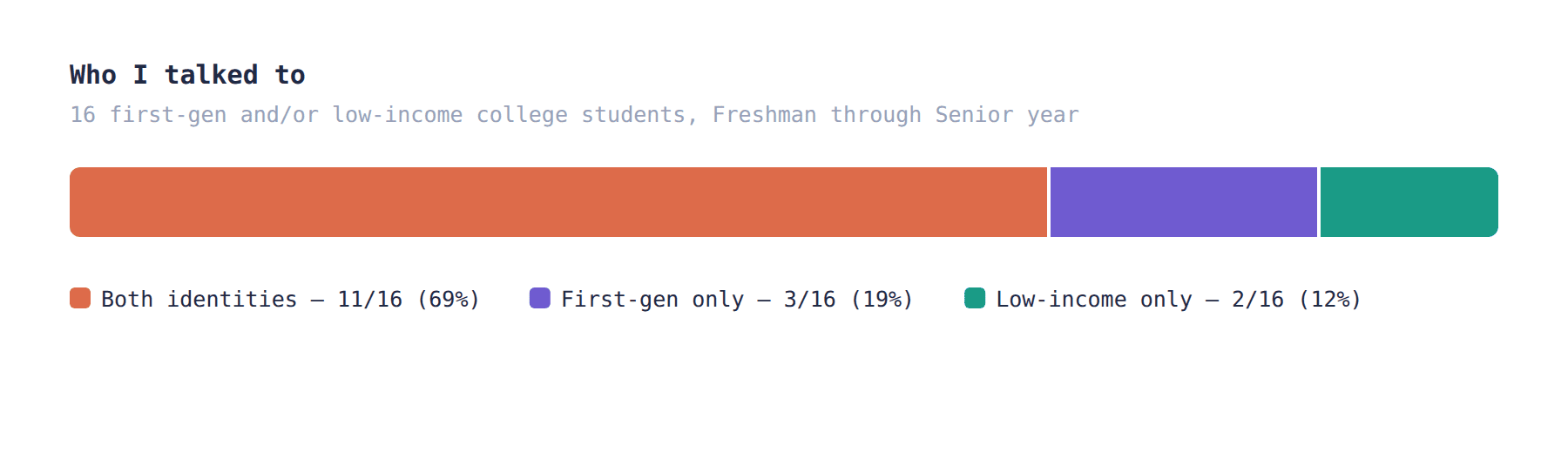
16 students responded — freshmen through seniors, across engineering, computer science, the arts, and the humanities. It's a small, self-selected sample from one method (a form), which I address directly in the reflection below — but even at this scale, the same handful of themes surfaced independently across enough respondents that I trusted them enough to build on.
Analysis
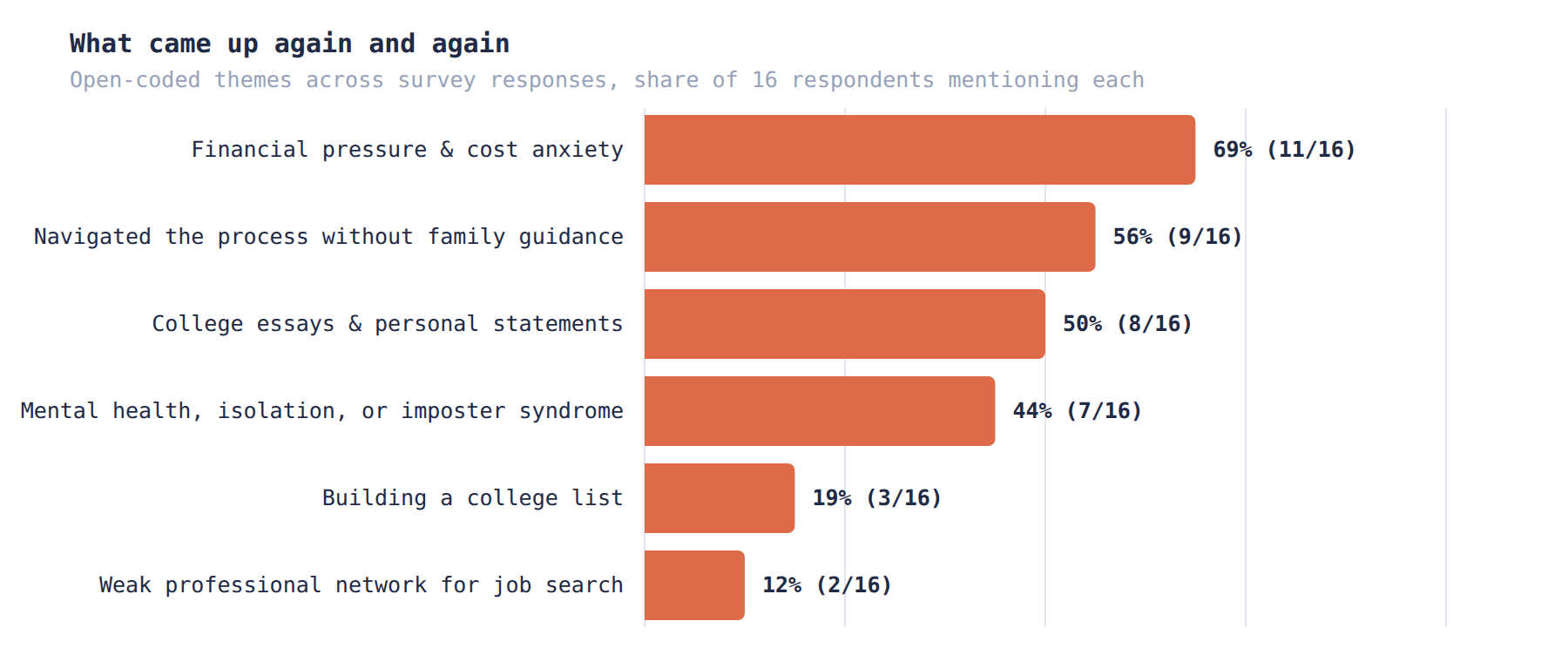
I didn't have research software for this — I read every response, open-coded each one into recurring themes by hand, then tallied how many respondents touched each theme across the application-challenges, "what I wish I knew," and career-impact questions. That's effectively affinity mapping done on paper: group the raw statements, name the pattern, count how often it repeats.
A few answers, in respondents' own words:
It felt like diving 12 feet under into a pool. It was so easy to drown in the new world of higher academia, it was so hard to watch my peers swim so easily against the tides.
My applications are all that I have, so I know that I am at a disadvantage as compared to someone who knows people who work at the company or are recruiters.
I am constantly thinking about money, so I try to maximize for that.
The closed-ended questions added a second layer I hadn't expected: I assumed the story would end at "the college application is hard." It doesn't.
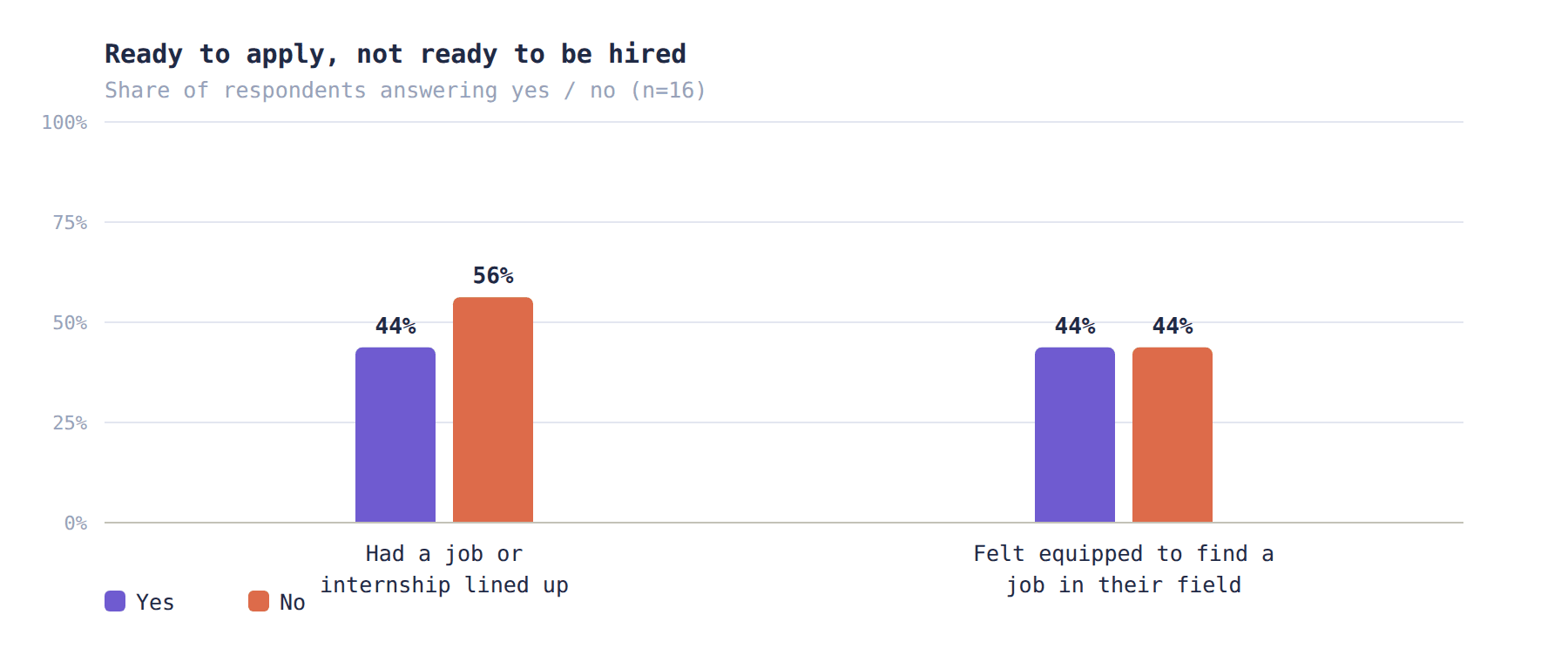
Having an internship or job lined up and feeling equipped to find one turned out to be closely tied together, not separate: 71% of respondents who already had something lined up also said they felt equipped to search in their field, compared to just 22% of those who didn't. Confidence tracked outcome far more tightly than I expected going in — a finding I hadn't designed the study to look for, which is exactly why I ran a survey broad enough to catch it.
From Insight to Product
Every major section of Trailmaker traces back to one of these themes, not the other way around:
- Financial pressure & navigating without guidance (69% and 56% of respondents) → Trailmaker's resource articles lead with financial aid and FAFSA content, and every article ends with next steps a student can act on immediately, so no one has to already know what to search for.
- Essays & personal statements (50%) → a dedicated resource track with concrete next steps, rather than generic "how to write an essay" advice.
- Mental health, isolation, and imposter syndrome (44%) → the "My Thoughts" section, a low-pressure space to write down doubts or questions, instead of only a task list that treats the process as purely transactional.
- Weak professional network for the job search (12%, 2 of 16) → a smaller signal than the other themes, but still the one I could not fully build for in v1. Trailmaker's first version focuses on getting into and through college; a few respondents specifically named networking as their gap in the job search, which is the clearest opening for where I'd take the product next.
Reflection
What I learned
- A survey is a net, not a scalpel. I expected the loudest finding to be about the application process. It was — but the survey was open enough to also surface the job-readiness gap, a finding I wasn't looking for. That's the argument for running broader, more open-ended instruments before narrowing to something targeted like a usability test.
- Self-selected samples have a point of view, and I should say so. All 16 respondents came from FGLI-specific programs and communities, which means they already had access to at least one support structure — the group Trailmaker most needs to reach (FGLI students with no such community) is underrepresented in this exact data. I'd weight a follow-up study toward reaching students outside existing FGLI programs specifically to test that blind spot.
- Manual thematic coding scales further than it looks like it should. With 16 respondents I could read and code every open-ended answer by hand and trust the result. I now know exactly where that method runs out — this is the point where I'd bring in a second coder to check my tags, or move to a tool like Dovetail once the response count outgrows one researcher's memory.